Showing posts with label indonesia. Show all posts

Saturday, September 26, 2020

Rujak Buni

Di Bogor semakin jarang melihat buah buni. Jangankan melihat, banyak pula yang tidak tahu buah buni. Apalagi rujak buni.

Spanduk yang menarik minat

 Saya menemukan seorang penjual rujak buni di daerah Sawah Baru, dekat pertigaan jalan Raya Dramaga dengan jalan baru yang menuju ke arah terminal Laladon. Sebelumnya saya telah beberapa kali melewati penjual tersebut, tetapi rasa penasaran saya tidak cukup kuat untuk menghentikan kendaraan yang saya kendarai dan membelinya, sampai akhirnya siang ini saya mampir juga.

Gerobak Rujak Buah Buni Bogor

Rujak buah buni menggunakan bahan-bahan yang sederhana antara lain buah buni segar yang telah berwarna merah, cabe rawit, gula merah, garam dan terasi. Hanya itu. Perbedaan rasa ditentukan oleh takaran rasio bahan-bahan tadi, tentu saja dengan buah buni sebagai bahan yang dominan.

Bang Fai, sang penjual rujak, pertama kali memasukan cabe rawit segar ke dalam ulekan berukuran lebar dan menggerusnya. Setelah halus, lalu gula merah, garam dan terasi dimasukkan kemudian digerus. Buah buni segar yang ditakar menggunakan cangkir plastik yang biasa digunakan untuk mengemas air minum dalam kemasan, langsung ditambahkan dan digerus dengan kuat sampai daging buahnya hancur. Hancuran buah huni tersebut mengeluarkan jus buah berwarna merah keunguan dengan jumlah cukup banyak sehingga tidak perlu ditambahkan air.


Bahan-bahan pembuatan rujak buni

Setelah seluruh bahan tercampur dengan rata, rujak buni segera dimasukan ke dalam kemasan gelas plastik ber tutup. Barang langka tersebut saya tebus dengan harga Rp. 15,000.

Semua Bahan Diulek Jadi Satu

Rasanya? Seger banget, lebih enak dan tidak sekecut dari yang saya bayangkan sebelumnya. Tapi ternyata memakan rujak huni ini memerlukan kesabaran juga karena biji buah buni tercampur pula di dalamnya. Bijinya keras dan banyak. Saya gak tahu bagaimana orang lain memakannya, apakah bijinya ikut ditelan atau tidak. Saya memilih dibuang setelah dikunyak-kunyah, lebih tepat dikulum-kulum karena bijinya keras, dan tidak ada rasanya lagi.

Rujak Buah Buni Dalam Kemasan

Sepertinya lebih praktis kalau dibuat jus ya?

Buah buni dihasilkan oleh pohon buni (Antidesma bunius). Saya belum pernah melihat langsung fotonya, kecuali dari foto hasil googling. Buahnya dapat dimakan segar, dibuat selai atau, konon di Filipina jus buah ini dibuat menjadi tuak. Buah ini disebut juga dengan boni, huni (Sunda), wuni (Jawa), bignai (Filipina).

Bang Fai, Penjual Rujak Buah Buni

Bang Fai sudah berjualan rujak buni di tempat tersebut sekitar 3 bulan dan bertempat tinggal di daerah Babakan Madang, dekat Sentul.

Kamu sudah pernah makan buah buni atau olahannya?

(Dramaga, 26 September 2020)


Tuesday, October 16, 2012

Yes, I climbed the Mt. Anak Krakatau

This time I will let those pictures do the talking:

I found a trip to Anak Krakatau offer in the facebook organized someone called himself Wisata Bahari. I replied the offer, so did other 30s people. I'd never met them before, except one: my work-mate Kelik. We met up on Sat Oct 6, 2012 at TPI (Tempat Pelelangan Ikan - Fish Auction) Lempasing in Bandar Lampung. The appointment was at 7am to leave the harbor. Kelik and I came there at 6:30am to meet none of them till 7am when Iwan and Geby showed up. After completing the waiting game, we finally left at 8:45am. The sky was not blue, it was grey. Really a mood killer for my photograph mission. But I was too excited to climb the Mt Anak Krakatau.
 
Three-hours sailing took us to Sebesi island. I didn't think it was a real island. To me it was another volcano in the middle of the sea, occupied by 2000s villagers. We had lunch on boat, and then harboring the island.

That afternoon we went to a snorkeling spot near the island. It was a big dilemma to me, to choose between swimming and taking pictures. Yogi encouraged me to taking pictures than swimming, and that was I did. The first spot had a strong underwater current, which forced us to pick another spot not far from Sebuku island. They were busy swimming and snorkeling and I was busy taking pictures and wondering why the pictures I took not as beautiful as expected :-(
We went back to Sebesi island in sunset time. Too bad, the Mt. Sebesi stood between my camera and the sun.
We had dinner on the island, tried singing karaoke to the song we were not familiar. Villager had special party, organ tunggal! For those who don't know what organ tunggal is, try googling it. We went to bed (not really a bed, just a mattress lying on the floor, with four of us on the top of it) for the big day the following morning. I didn't know who snored louder than me, if any.


We started the day early. I woke up at 3am and we left Sebesi island the next hour. The plan was to climb the Mt. Anak Krakatau and observing sunrise on the top of it. The wind was strong, the waves was high, but my eyes were sleepy still. The boat headed south to Mt. Anak Krakatau. One hour later I saw a volcano and thought it was Mt. Anak Krakatau until I look at the other side of the boat. Then there was Mt. Anak Krakatau which was smaller than the first volcano I saw, Mt. Rakata.
It was still too dark to take any picture, especially if you're on moving boat. We arrived at Mt. Anak Krakatau, apparently too late to climb before sunrise. There were some speed boats on the beach, and I saw some tents on the island. They must be camping there from the night before.

We landed at the part of the island with vegetation. The beach had black volcanic sand. There was a ranger station nearby, a hut and a big name sign welcoming us said "Cagar Alam Krakatau" (Krakatoa Natural Reserve). I was lucky enough to be there early. I bet this name sign would be a favorite place to take picture by visitors, and it would be too crowded, not fun.

Surprise, Minnie was here! I can't imagine somebody brought Minni Mouse to Mt. Anak Krakatau. We're living in the same planet anyway, right?

I was intimidated by some pictures of Mt Anak Krakatau in the internet. Conical shape would be tough to climb, the loose sand on the volcano surface would add the suffer. Did I mention those sulphuric smokes everywhere?
I decided to wear a hiking sandals after looking at some pictures of people climbing this volcano wearing hiking sandals, on the facebook. This decision which I regretted later. But hey, look at the picture above. It seemed to be a fun hike that morning..... initially.

But then. the forest disappeared... but I still had my hat.


The soil got softer, it was completely sand. Whenever you stepped, your foot got sink. You climb
ed three steps up and the gravity pulled you down by a step. To my surprise, the surface was full of dried granulated mud. And I tell you, it was hard with sharp edges. You just don't want to get it stuck between your sandal and your feet. It hurts!
Please wear good high hiking-shoes with thick socks.

You would find a lot of holes on the surface of Mt. Anak Krakatau with different size. I found one with approx. 1 meter depth, as picture above (with Geby, Kelik and Iwan left to right). I always found one dried ball of mud in each hole. It must be a kind of volcanic bomb, thrown away from underground.

I had good reasons for posing:
1. It's a proof I was there
2. Posing gives you time to catch your breath, elegantly. You don't want to let people to see you running out of breath, right? Try posing or acting like taking lots of picture
The angelic face of Mt Anak Krakatau, facing to the west. It looked smooth, quiet, just like smiling at me!

We met a yacht which visited Mt Anak Krakatau. The government of Lampung Province held the annual Krakatau Festival, this year at Oct 6-7 2012. One of the attraction was a visit to Mt Anak Krakatau. I thought this yacht was carrying the VIP guests.
I was wondering what the hell they were doing over there

The devilish face of Mt. Anak Krakatau, facing to the east. It represents powerful anger, show-no-mercy attitude. The volcanic mud/lava keep flowing to the sea. No vegetation on the beach. This is how the island size is growing constantly, also the height. Wikipedia stated that Anak Krakatau has grown at an average height of five inches per week (eq. 6.8m/year) since 1950s

Mt. Anak Krakatau, as seen from the sea when we were leaving the island. You could only climb up to the hill in front of the main dome. You will see a valley between the hill and the main dome behind. You may see some footpaths with lighter color on the hill in the picture above. This is the only part of the island with vegetation and sandy beach.

Mt. Anak Krakatau (foreground) and Mt. Rakata (background, taller volcano)

We used this vessel for the trip. KM Singa Laut was designed as a fishing vessel, for hobby not commercial fishing. Made of wood, equipped with radio communication system, a room with AC-system, a pantry, a toilet and a common room for singing karaoke! It was a fast vessel.

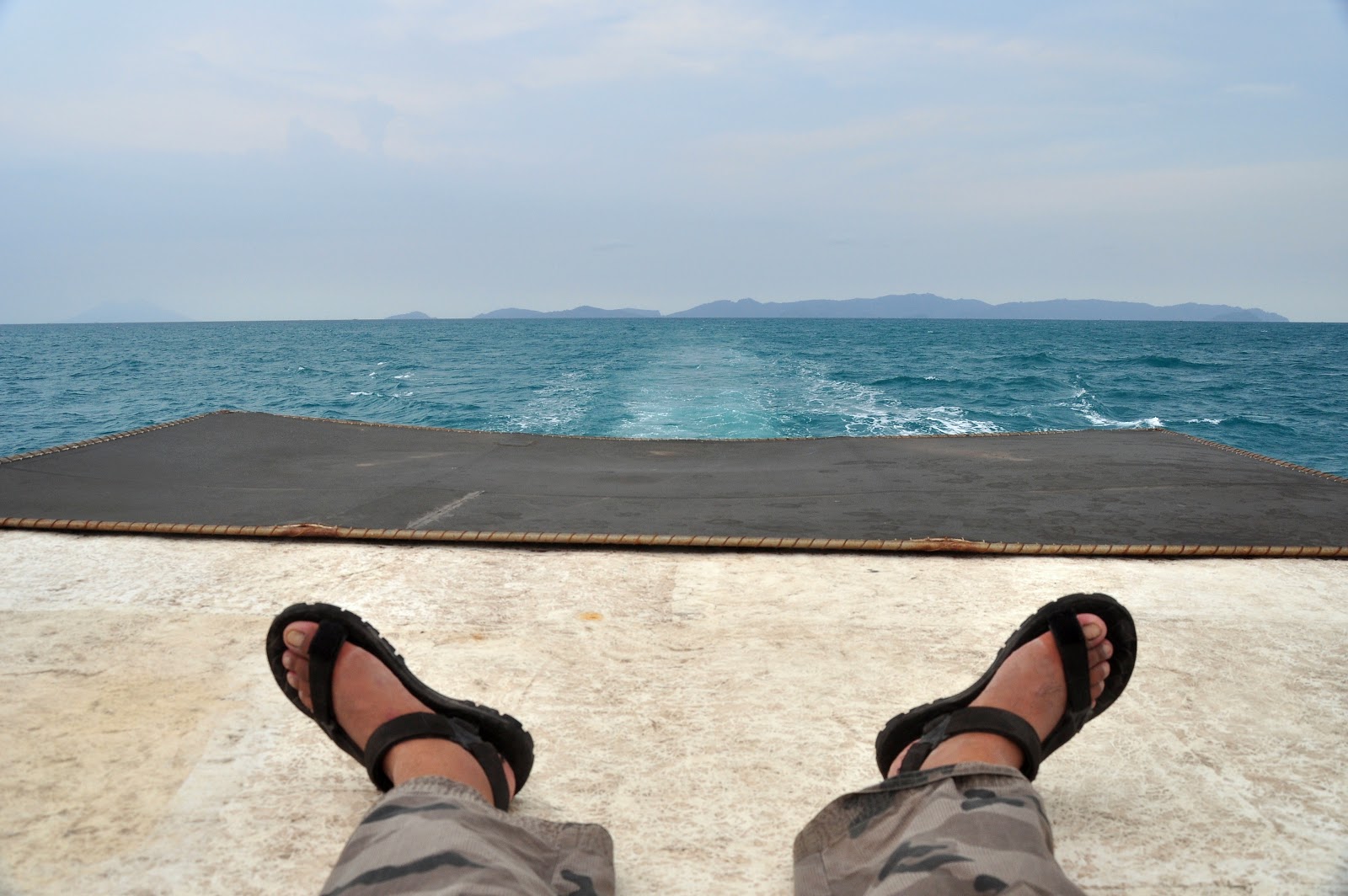
On the way back to Lempasing, sit back and relax on the top of the boat. There was no other better place to enjoy the ride and taking pictures than on the top of the boat. Nothing would block your view. This was how I got my sunburn.

The 2Days-1Night trip ended here, Sun Oct 7, 2012 4pm the harbor at TPI Lempasing. I got severe sunburn on my arms and face. I was not sure how I should prepare my weary body to attend a wedding party in the evening that day. I was worried with my camera. Salt water, sweat, and volcanic dust are not get along with camera and coated lenses.


Wednesday, October 3, 2012

The Mystical Dieng's Temples

I visited Dieng plateau in the highlands of Central Java, Indonesia back in May 2010 as my very first visit. The plateau actually sits at the floor of ancient giant caldera of mount Prahu. You could find at least 8 craters, high geothermal potential, and volcanic gas emission which sometime is deadly. Let's leave alone those volcanic stuffs.

It has 6 lakes including Telaga Warna. If you happen to be there, don't forget to observe sunrise. Mount Sikunir is one of the most popular spot to observe sunrise. I have a post on observing sunrise in Dieng in this link, here.

Dieng also is a home to some oldest Hindu temples in Indonesia. There are 4 group of temples in Dieng:
  1. Arjuna temple complex, consist of Temple Arjuna, Temple Semar, Temple Srikandi, Temple Sembadra, and Temple Puntadewa
  2. Temple Gatutkaca
  3. Temple Dwarawati
  4. Temple Bima

I visited Arjuna complex and Temple Bima only, due to time shortage. I took some pictures of those temples.

Tips: weather in Dieng may change very quick. Morning time is the best time for taking pictures before dark clouds coming at you at noon time.

Temple Bima

The entrance to Temple Bima

Temple Bima - rear view

Temple Bima

Arjuna Complex


The name sign of temple Arjuna complex

Temple Arjuna (left) facing temple Semar (right)

Temple Arjuna
  
Temple Semar

One of reliefs

Temple Srikandi (left), Temple Sembadra (middle), Temple Puntadewa (right)

A view of Temple Srikandi and Sembadra, from the inside of Temple Semar

Sunday, June 27, 2010

Menyiapkan Kopi a la Vietnam

Alat & Bahan:

penyaring atas, wadah penyaring, tutup (kiri ke kanan)
Penyaring kopi (dalam bahasa Vietnam: phin cà phê), cangkir, sendok, kopi bubuk kasar (coarse ground coffee)

Langkah 1. Masukkan bubuk kopi ke dalam penyaring

Biasanya penyaring kopi Vietnam terdiri dari 3 bagian: (1) wadah penyaring, (2) penyaring atas, (3) tutup. Wadah penyaring diletakkan di atas cangkir. Masukkan kopi bubuk sebanyak kurang lebih 3 sendok teh penuh. Ratakan permukaannya.

Takaran satu sendok teh penuh

Langkah 2. Tutup dengan penyaring atas, tekan dengan lembut

Letakkan penyaring atas di atas kopi
Letakkan penyaring atas menutupi kopi, tekan dengan lembut agar kopi lebih padat. Langkah ini bertujuan untuk mengurangi udara yang terperangkap di antara serbuk kopi sehingga air tidak mengalir terlalu deras.
  
Tekan agar lebih padat


Langkah 3. Masukkan air panas


Air mendidih lebih baik
Masukkan air panas perlahan-lahan sampai penuh. Disarankan menggunakan air mendidih karena akan mengekstrak kopi lebih baik. Air panas dari dispenser pun bisa digunakan dan hasilnya tidak terlalu mengecewakan.

Langkah 4. Tutup dan tunggu

Setelah air panas dimasukkan, tutup penyaring kopi untuk mempertahankan suhu air. Air panas akan mengalir perlahan melalui serbuk-serbuk kopi. Air yang jatuh ke cangkir sudah berwarna hitam dengan aroma kopi yang kuat. Citarasa kopi yang dihasilkan akan semakin kuat jika air menetes lambat dan suhu air tinggi.

Biarkan air menetes habis
Di Vietnam proses ini dilakukan sekali sehingga air kopi yang dihasilkan sedikit tetapi sangat kental. Saya biasa menambahkan air panas sekali lagi setelah air yang pertama turun semua karena masih banyak citarasa kopi yang tertinggal di dalam serbuk kopi.

Untuk sebagian orang di Indonesia, proses menyiapkan kopi a la Vietnam ini terlalu lama dan ribet dibandingkan menyeduh dengan memasukkan kopi bubuk dan gula ke dalam cangkir, masukkan air panas dan mengaduknya. Tapi percayalah, rasa kopi yang dihasilkan sangat mantap, nendang! 

Langkah 5. Nikmati kopi a la Vietnam

Kopi a la Vietnam
Kopi anda sudah siap. Orang barat biasanya meminumnya langsung tanpa penambahan gula atau creamer. Katanya kalau ditambah gula, bisa menutupi rasa kopi aslinya. Saya pun terbiasa tidak menambahkan gula, tetapi kadang-kadang saya tambahkan 1 sendok teh gula pasir.

Tips
  • Gunakan bubuk kopi dengan butiran agak kasar. Kopi bubuk yang tersedia di Indonesia biasanya terlalu halus sehingga mudah lolos dari saringan. Saya biasanya membeli kopi yang masih berbentuk biji, kemudian digiling dengan blender (atau coffee grinder / miller).
  • Orang Vietnam menggunakan sedikit gula pasir yang dicampur belakangan sesuai selera. Susu kental manis juga populer digunakan sebagai campuran. Biasanya susu kental manis sudah dimasukkan ke dalam cangkir terlebih dahulu sebelum kopi.
  • Kopi ini juga enak dikonsumsi dalam keadaan dingin dengan cara menambahkan es batu. Cà phê sữa đá (cà phê = kopi, sữa = susu, đá = es batu) sangat populer di Vietnam terutama di musim panas.

Saturday, June 12, 2010

Telaga Warna

This is the second part of my trip story to Dieng plateau, the first one is my previous post Sunrise Above The Clouds.

Observing the sunrise from the top of Sikunir hill requires you to get up early at 4-am and climb the hill for 25 minutes, if you stay in Dieng village. But if you stay in Wonosobo, you need to leave the town at 3-am. The "show" would last till 6.30-am. Still early for a breakfast. Then you have time to do something before having breakfast. Telaga Warna is just right there for you by being located between Sikunir hill and Dieng village.

Telaga Cebong in the shade

I was surprised when I saw a lake from the point I started climbing Sikunir hill that morning. I knew I was there before, and been told there was a lake there. But it was to dark to see anything. It was Cebong lake, named after its tadpole shape ((ke)cebong is tadpole in Indonesian). I was not sure if its shape really looked like a tadpole or not. That was not important, the lake was nice. Hiding in the shadow of ajoining hill. Taking its picture was difficult since its extreme contrast. After taking some pictures I continued my trip to Telaga Warna.

The main gate to Telaga Warna

The high roof main gate to Telaga Warna make it seen easily. The car park was at the main gate's opposite side of the road. I came in at 7-am after paying the ticket. Visiting this lake that early gave me huge advantage, no crowd! As soon as I enter the gate, the strong sulfuric smell hanging in the air just like at many other places in Dieng plateau.

The green colored water of Telaga Warna
 The water was green, I couldn't see anything in it. No small fish, no waterbugs, it just lukewarm acidic water. Some birds were swimming in the lake, they must be taking a bath. I believed it was called Telaga Warna due to its green colored water.  I walked further following a con-block pathway around the lake. It led me to a statue. It was Gajah Mada statue in golden color, with a closed cave by it. It was a sacred meditation place. I soon found out that Telaga Warna site not only had a lake, but also 4 caves/places for meditation: Batu Tulis, Gua Semar, Gua Sumur, and Gua Jaran (Gua is cave in Indonesian). I was not sure if they were still used currently, all were closed.


Gua Batutulis, guarded by Gajah Mada statue
Gua Semar entry
A statue at the Gua Sumur entry


All of the mediation caves were located in a kind of dyke between Telaga Warna and Telaga Pengilon. If Telaga Warna gave me a sterile impression by not having fishes in it, Telaga Pengilon was rich of life. Fishes, bugs, tadpoles, more birds and... fishermen. It had brownish colored water.

I wished I could get to a higher place for a better view on the lakes. God answered my wish, even though I had to punish my lung and legs for a climbing a hill for the second time that morning..... and the view was amazing! Telaga Warna, Telaga Pengilon were there. Mount Sindoro in the background was a big bonus.


Telaga Warna with Telaga Pengilon and mount Sindoro in the background
I took some pictures and gave my lung and legs time to recover before I went down for a breakfast and another destination in Dieng.

Another view to the lake

Click here for more pictures.


Iman
Pemalang, June 13 2010